
Short Answer
The high Arctic archipelago of Franz Josef Land has served as a strategic stepping‑stone for several early 20th‑century attempts to reach the geographic North Pole. Its northern islands lie within 200 km of the pole, offering a relatively short sled route across the polar ice cap. Between 1895 and 1902, at least three major ventures—Nansen and Johansen’s wintering, Walter Wellman’s 1898–99 America expedition, and the Baldwin‑Ziegler Polar Expedition of 1901–02—used the archipelago as a base of operations.
These early attempts combined scientific programmes (meteorology, geology, magnetic observations) with the logistical challenge of moving men, supplies, and hundreds of sled dogs across ever‑changing sea ice. While none succeeded in standing on the pole, each contributed valuable cartographic data, refined sled techniques, and highlighted the limits of contemporary Arctic technology.
The Baldwin‑Ziegler venture, financed by American industrialist William Ziegler and commanded by meteorologist Evelyn Briggs Baldwin, represents the most heavily documented of these early efforts. Its ambitious plan, massive logistical support, and dramatic failure illustrate the harsh realities of polar exploration at the turn of the century.
Who Was Evelyn Briggs Baldwin / The Expedition
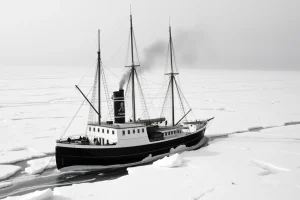
Evelyn Briggs Baldwin (1864–1910) was an American meteorologist who had previously taken part in Walter Wellman’s 1898 Franz Josef Land expedition. Ziegler, who had amassed a fortune from baking‑powder production, offered Baldwin “unlimited means” and a direct order: “Find the Pole, and don’t come back until you do.” The expedition assembled a multinational crew of 42, including Swedes, Russians, a Norwegian, and a Dane, and chartered three three‑masted steamships:
- America (466 net tons, formerly *Esquimaux*) – flagship.
- Frithjof (260 tons) – former supply vessel for Wellman’s 1898 venture.
- Belgica – the former Belgian Antarctic Expedition ship, repurposed as a support vessel.
The expedition also carried 15 ponies and an impressive 428 sled dogs, as well as a suite of experimental communication balloons equipped with message buoys.
Objectives
The primary objective was a direct sledge march from a northern base on Franz Josef Land to the geographic North Pole (90° N) and back via the Arctic westward ice drift. Secondary goals included:
- Systematic meteorological and magnetic observations across the high Arctic.
- Geological sampling of Jurassic–Cretaceous marine sediments and basaltic outcrops.
- Mapping of previously uncharted islands and straits within the archipelago.
- Testing of balloon‑borne message buoys as a long‑range communication system.
Route
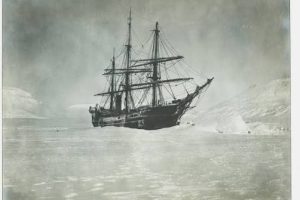
The expedition set sail from Vardø, Norway on 27 July 1901. After rendezvousing with the Frithjof at Cape Flora, both ships entered the channels of Franz Josef Land, aiming for a winter base on Rudolf Island. Sea ice forced an early landing on Alger Island, where Baldwin established “Camp Ziegler.” The three ships were eventually iced in on the shore of Alger Island for the winter of 1901–02.
In spring 1902 the party began a relay‑depot system, moving supplies northward to “Kane Lodge” on Greely Island, a depot on Coburg Island, and finally a third at Cape Auk on Rudolf Island. From there Baldwin intended to launch a dog‑sled team toward the pole in the summer of 1902, with a planned return route across the polar ice drift toward Greenland, where Johan Bryde was to have pre‑positioned supply caches.
Timeline
| Date | Event |
|---|---|
| 27 July 1901 | America departs Vardø, Norway. |
| Early August 1901 | Frithjof meets America at Cape Flora; both proceed into Franz Josef Land. |
| Mid‑August 1901 | Ships forced to off‑load at Alger Island; Camp Ziegler established. |
| Winter 1901–02 | America iced in; crew overwinter on Alger Island. |
| April 1902 | Relay depots established on Greely, Coburg, and Rudolf Islands. |
| 14 May 1902 | Baldwin locates the 1895/96 Nansen hut on Jackson Island. |
| Late May 1902 | Balloon‑borne message buoys launched requesting coal resupply. |
| 1 August 1902 | America departs Alger Island for Honningsvåg, Norway, without receiving any balloon messages. |
The Franz Josef Land Connection
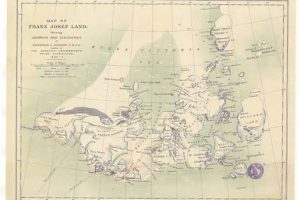
Franz Josef Land provided the only accessible high‑latitude landmass within practical sailing distance of the pole. Baldwin’s winter camp on Alger Island (near 81° N) allowed the expedition to conduct extensive coastal surveys, confirming that Ziegler Island, Champ Island, and Luigi Island were distinct entities rather than a single landmass—a correction to earlier Austro‑Hungarian maps.
By excavating the abandoned Nansen‑Johansen hut on Jackson Island, Baldwin’s team also verified the exact location of the 1895 winter encampment, adding valuable topographic detail to contemporary charts.
Challenges and Hardships
Ice conditions proved the expedition’s greatest obstacle. The initial attempt to push northward by ship was repeatedly blocked, forcing an early winter on Alger Island. Maintaining steam pressure to keep the America from being crushed by icebergs consumed coal at an unsustainable rate, prompting Baldwin to dispatch 15 balloons carrying 300 messages in hopes of locating a resupply vessel. None of the messages were recovered.
Logistical complexity was amplified by the sheer number of sled animals; feeding 428 dogs and 15 ponies required large stores of seal meat and hay, much of which had to be hauled across treacherous ice. Internal discord also emerged: crew members later accused Baldwin of drunkenness, refusal to provide essential equipment, and a lack of genuine ambition to reach the pole.
Discoveries and Achievements
Although the pole was never reached, the Baldwin‑Ziegler expedition produced several enduring contributions:
- Accurate mapping of the central Franz Josef Land archipelago, correcting earlier cartographic errors and establishing the separate identities of Ziegler, Champ, and Luigi Islands.
- Photographic documentation of ice conditions, wildlife, and the Nansen hut, later used by subsequent researchers.
- Scientific observations of temperature, atmospheric pressure, and magnetic variation collected over the 1901–02 winter.
- Experimental use of hydrogen‑filled balloons for long‑range communication, a concept that would not be revisited until the mid‑20th century.
Outcome and Fate
America returned to Norway on 1 August 1902, ending the first major American‑financed pole attempt from Franz Josef Land. Upon arrival, Ziegler was displeased with the expedition’s limited progress and the internal accusations levied against Baldwin. Ziegler terminated Baldwin’s command, reorganized the venture, and appointed photographer Anthony Fiala to lead a second, better‑funded attempt in 1903–04 (the Fiala‑Ziegler expedition).
Historical Significance
Historians view the Baldwin‑Ziegler expedition as a turning point in Arctic exploration strategy. It demonstrated that sheer financial backing and a large inventory of sled dogs were insufficient without reliable ice navigation and realistic logistical planning. The failure also underscored the importance of wintering on solid land for accurate surveying, a lesson incorporated into later Soviet and American polar programs.
Primary Sources
Surviving documentation includes Baldwin’s own narrative published in 1903, the official ship logs of the America, Frithjof, and Belgica, and a series of photographs taken by expedition photographer Anthony Fiala. These records were later incorporated into the United States National Archives and the American Geographical Society’s collections, providing a detailed primary‑source basis for modern scholarship.
Related Expeditions
Earlier attempts that set the stage for Baldwin’s venture include Fridtjof Nansen and Hjalmar Johansen’s 1895–96 winter at Cape Flora, where they survived a polar night and demonstrated the feasibility of overwintering on Franz Josef Land. Walter Wellman’s 1898–99 America expedition, also financed by American capital, attempted a direct pole march but was halted by impenetrable ice, prompting Wellman to retreat to Norway.
Later, the Fiala‑Ziegler expedition (1903–04) built on Baldwin’s logistical framework, establishing a more permanent base at Cape Flora and ultimately reaching a latitude of 86° 14′ N, the furthest north achieved by a surface party until Roald Amundsen’s airship Norge in 1926.
FAQ
Why was Franz Josef Land chosen as a base for North Pole attempts?
Its northern islands lie within a few hundred kilometres of the pole, providing solid land for wintering, a platform for sled launches, and relatively accessible sea routes during the brief Arctic summer.
How many dogs did Baldwin bring, and why so many?
The expedition carried 428 sled dogs, a number required to haul heavy supply caches across the unstable polar ice and to allow for replacement of exhausted teams during the long sled march.
What was the purpose of the balloons used by Baldwin?
Baldwin equipped 40 hydrogen‑filled balloons with strings of message buoys intended to be released at sea‑level contacts, hoping to transmit requests for coal resupply; none of the messages were ever retrieved.

Leave a Reply