
Short Answer
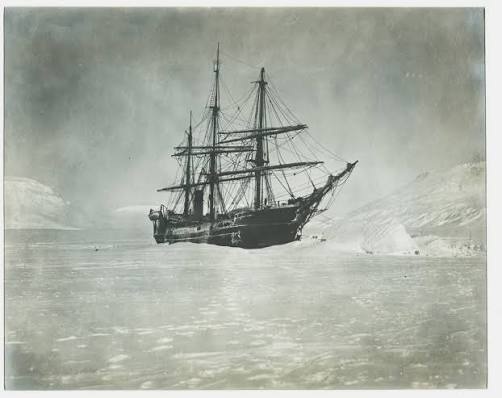
The Baldwin‑Ziegler Polar Expedition of 1901‑1902 represented one of the most heavily funded but ultimately unsuccessful attempts to reach the North Pole in the early twentieth century. Sponsored by the American baking‑powder magnate William Ziegler and commanded by the American meteorologist Evelyn Briggs Baldwin, the venture set out from Norway with three three‑masted steamships, a large contingent of sled dogs, ponies, and a novel balloon‑based messaging system. Although the expedition never reached the Pole, it left a complex legacy of logistical innovation, internal discord, and a dramatic reshaping of subsequent American Arctic endeavors.
Who Was the Expedition
Evelyn Briggs Baldwin (1877‑1969) was a trained meteorologist who had previously taken part in Walter Wellman’s 1898 attempt on Franz Josef Land. William Ziegler (1844‑1905) made his fortune in baking powder and, motivated by national prestige and personal ambition, offered Baldwin “unlimited means” to find the Pole, famously instructing him to “Find the Pole, and don’t come back until you do”.
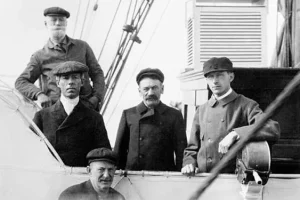
The expedition assembled a multinational crew of 42 members, including Swedes, Americans, Russians, a Norwegian, and a Dane. Notable personnel were physicist and geologist Ernest de Koven Leffingwell, cartographer Ejnar Mikkelsen, photographer Anthony Fiala, and medical officers William Verner and Charles Seitz. The three ships were:
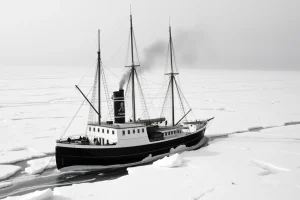
- America (466 net tons, formerly *Esquimaux*) – flagship, commanded by sailing master Carl Johanson.
- Frithjof (260 tons) – former Wellman supply vessel.
- Belgica – ex‑Belgian Antarctic Expedition ship, used for auxiliary support.
In total, the expedition carried 15 ponies, 428 sled dogs, and 40 hydrogen‑filled balloons designed to drop message buoys during the Arctic summer.
Objectives
The primary aim was a direct sprint to the North Pole from a northern base on Franz Josef Land, followed by a return via the natural westward drift of sea ice toward Greenland. Secondary scientific goals included meteorological observations, magnetic and geomagnetic measurements, geological sampling, and mapping of previously uncharted islands and straits in the archipelago.
Route
The fleet departed Vardø, Norway on 27 July 1901, sailing eastward toward the Franz Josef Land archipelago. After rendezvousing with the Frithjof at Cape Flora, the ships attempted to navigate the narrow channels to establish a winter base, preferably on Rudolf Island (Ostrov Rudolfa). Heavy pack ice forced the vessels to anchor at Alger Island, where Baldwin established “Camp Ziegler”.
During the 1901‑1902 winter the ships remained ice‑bound. In spring 1902, a relay of supply depots was created across the archipelago, with three major stores at “Kane Lodge” (Greely Island), Coburg Island near Karl‑Alexander Island, and Cape Auk on Rudolf Island. After the depots were set, Baldwin planned a sledge push toward the Pole for the following summer, but instead turned to exploratory forays, including the rediscovery of Fridtjof Nansen’s 1895‑96 winter hut on Jackson Island on 14 May 1902.
Timeline
| Date | Event |
|---|---|
| 27 July 1901 | Departure from Vardø, Norway. |
| Early August 1901 | Meeting with Frithjof at Cape Flora; attempt to reach Rudolf Island. |
| Mid‑August 1901 | Ice blocks progress; ships forced to off‑load at Alger Island; Camp Ziegler established. |
| Winter 1901‑1902 | Ships iced in; preparation of relay depots across the archipelago. |
| 14 May 1902 | Baldwin locates Nansen’s abandoned hut on Jackson Island. |
| Late May 1902 | Balloon‑borne message buoys dispatched requesting coal resupply. |
| 1 August 1902 | America breaks free, sails to Honningsvåg, Norway, without receiving any messages. |
| August 1902 | Ziegler relieves Baldwin; appoints Anthony Fiala to lead a renewed attempt (the Fiala‑Ziegler Expedition). |
The Franz Josef Land Connection
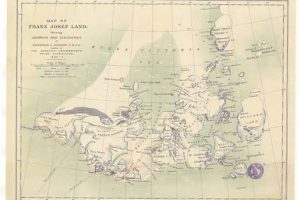
Franz Josef Land served both as the launchpad and the primary theater of operations. The expedition’s winter base on Alger Island lay within the Zichy Land group, a cluster of islands that Baldwin’s surveys later clarified as distinct entities (Ziegler Island, Champ Island, Luigi Island). The series of depots established in spring 1902 contributed to the first systematic mapping of the archipelago’s interior, correcting earlier misconceptions from the Austro‑Hungarian (1873) and Jackson‑Harmsworth (1895) charts.
Challenges and Hardships
Ice conditions proved the decisive obstacle. The dense pack prevented the ships from reaching the intended northernmost base, forcing repeated off‑loading and the construction of ad‑hoc depots. The need to keep the America under continuous steam to avoid hull damage drained coal reserves, prompting the ill‑fated balloon‑messaging campaign. Health problems were limited but morale suffered; contemporary accounts record accusations of Baldwin’s drunkenness, refusal to provide essential equipment, and an overall lack of ambition to reach the Pole. Internal rivalries culminated in public criticism after the expedition’s return.
Discoveries and Achievements
Although the Pole remained unreached, the expedition accomplished several notable feats:
- Systematic depot network across Franz Josef Land, enabling later parties to stage deeper penetrations.
- Confirmation and detailed mapping of Zichy Land’s separate islands, refining the cartographic record established by earlier explorers.
- Rediscovery of Nansen’s 1895‑96 winter hut on Jackson Island, providing valuable historical context for polar habitation.
- Experimental use of hydrogen balloons for long‑range communication, a concept later revisited in Arctic research.
Outcome and Fate
The expedition returned to Norway on 1 August 1902, where Baldwin faced public accusations from crew members, notably sailing master Carl Johanson, of mismanagement and personal misconduct. William Ziegler, dissatisfied with the limited results, dismissed Baldwin and commissioned a second, better‑funded attempt under Anthony Fiala, known as the Fiala‑Ziegler Expedition (1903‑1905). Baldwin’s personal contracts, which had re‑engaged crew members at a nominal $5 per month and prohibited public accounts, were later invalidated, allowing participants to publish their testimonies.
Historical Significance
Historians view the Baldwin‑Ziegler venture as a cautionary episode illustrating the perils of under‑estimating Arctic ice dynamics and over‑reliance on untested technology. The expedition’s logistical scale foreshadowed later, more successful American polar efforts, while its internal controversies highlighted the importance of clear command structures in extreme environments. The depot system and refined cartography directly aided the subsequent Fiala‑Ziegler and later Soviet explorations of the archipelago.
Primary Sources
The principal documentary legacy consists of Baldwin’s own 1901 and 1903 reports, the ship’s logbooks (preserved in the U.S. National Archives), and personal diaries of crew members such as Ernest de Koven Leffingwell and Anthony Fiala. Contemporary newspaper coverage, especially Ziegler’s own press releases, provide insight into the public perception and the post‑expedition controversy. Modern scholars have drawn on these primary materials in works such as Capelotti’s 2016 monograph on Arctic exploration.
Related Expeditions
The Baldwin‑Ziegler effort sits between the earlier Wellman attempts (1898‑1900) and the later Fiala‑Ziegler Expedition (1903‑1905). It also connects to the historic wintering of Fridtjof Nansen and Hjalmar Johansen at Cape Flora (1895‑96) and to the 1914 Duke of the Abruzzi’s march from Rudolf Island to the Pole, which built upon the depot infrastructure first laid by Baldwin’s party.
FAQ
What was the main purpose of the Baldwin‑Ziegler Polar Expedition?
The expedition aimed to reach the geographic North Pole from a northern base on Franz Josef Land and to conduct scientific observations of meteorology, magnetism, geology, and Arctic geography.
Why did the expedition fail to reach the North Pole?
Heavy pack ice prevented the ships from establishing a northern base, the depot network was incomplete, and logistical problems such as coal shortages and internal disputes undermined the planned sledge push.
What happened to the expedition after it returned to Norway?
William Ziegler dismissed Baldwin, appointed Anthony Fiala to lead a new attempt, and the crew publicly criticized Baldwin’s leadership, leading to a lasting controversy in the history of American Arctic exploration.


Leave a Reply