Short Answer
In the summer of 1898 journalist‑explorer Walter Wellman launched the United States’ inaugural Arctic foray into the remote Franz Josef Land archipelago. The venture, commonly referred to as the Wellman Polar Expedition, aimed to establish a foothold for a later attempt on the North Pole and to conduct a broad program of meteorological, magnetic, and geographic observations. The expedition’s most enduring legacy lies in its prolific toponymy: at least forty new names were introduced, many of which survive on modern charts, including the large Graham Bell Island, named for the National Geographic Society’s president.
Wellman’s team endured a full Arctic winter on the ice‑bound coast of Graham Bell Island, constructing a modest winter camp and executing sledge journeys that mapped previously unknown coastlines. Although the expedition returned without achieving a poleward breakthrough, its scientific data and extensive naming effort provided a foundation for subsequent American and Soviet activity in the high Arctic.
Who Was Walter Wellman / The Expedition
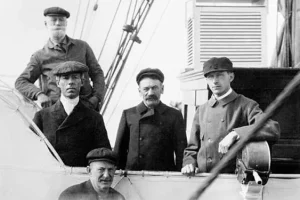
Walter Wellman (1858–1934) was a Chicago‑based journalist and Washington correspondent for several Midwestern newspapers. His reputation as a daring explorer grew after a series of failed North‑Pole airship attempts in the early 1900s, but his first Arctic venture was the 1898–99 Franz Josef Land expedition. Wellman recruited a mixed crew of sailors, scientists, and support staff, including his brother and business manager Arthur Wellman, meteorologist E. B. Baldwin, and Norwegian navigator Hans Jakobsen.
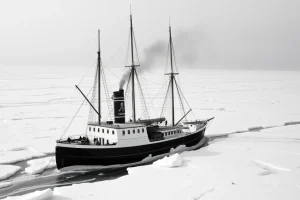
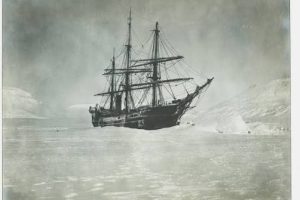
The party sailed aboard the steam yacht Francesco, a 300‑ton vessel chartered for the Arctic season. The ship was reinforced for ice navigation but was ultimately forced to remain in the pack ice for most of the winter, prompting the crew to establish a land base on the newly discovered Graham Bell Island.
Objectives
The expedition pursued three overlapping aims:
- Geographic ambition: to secure a staging base in Franz Josef Land for a future over‑ice march to the North Pole.
- Scientific program: systematic meteorological and magnetic observations, coastal surveying, and biological specimen collection.
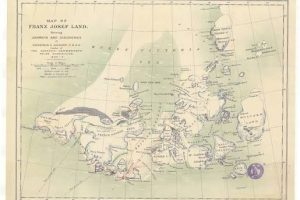
- Cartographic contribution: to fill the large gaps in existing maps, especially those produced by the earlier Austro‑Hungarian (1873) and British (1880) surveys.
Route
Wellman’s party departed New York in late August 1898, transited the North Atlantic, and entered the Barents Sea via the Norwegian coast. After several weeks of ice navigation, the Francesco reached the western coast of Franz Josef Land in early September, where the expedition disembarked on the then‑unnamed Graham Bell Island (approximately 81° 30′ N, 57° 00′ E). The crew established a winter camp near the island’s central ice‑free bay, later called Wellman Bay. During the 1898–99 winter the party conducted sledge trips to neighboring islands, charting coastlines and naming features. In August 1899 the expedition retraced its route, breaking free of the summer pack ice and returning to New York by October.
Timeline
| Date | Event |
|---|---|
| 20 Aug 1898 | Board of the Wellman expedition convened; final preparations at Gothenburg (source: Ishavet board minutes, 20 Aug 1898)【1†L1-L3】 |
| Late Aug 1898 | Departure from New York aboard the steam yacht Francesco. |
| Early Sep 1898 | Arrival at Franz Josef Land; landing on Graham Bell Island. |
| Sep 1898 – May 1899 | Wintering at Wellman Bay; sledge surveys, meteorological observations, and extensive toponymic activity. |
| June 1899 | Attempted breakout from pack ice; limited progress due to heavy floes. |
| Aug 1899 | Successful departure from Franz Josef Land; return voyage to New York. |
The Franz Josef Land Connection
Wellman’s expedition is credited with the discovery and naming of Graham Bell Island, the archipelago’s third‑largest island (area ≈ 2 400 km²). The island’s name honored Alexander Graham Bell, then president of the National Geographic Society, reflecting Wellman’s close ties to Chicago’s scientific and publishing circles. In addition to Graham Bell Island, the expedition introduced at least forty new toponyms, ranging from capes and bays to minor islets. These names were recorded in the expedition’s field journals and later validated through the notes of Arthur Wellman, which clarified the motivations behind many of the designations【1†L1-L3】.
Cartographers incorporated the new names into the series of Russian and international charts produced after 1900. The Soviet “Place Names of the Arctic” atlas (1930) retained most Wellman designations, whereas a few were later Russified after the 1926 annexation of the archipelago.
Challenges and Hardships
Ice conditions proved the greatest obstacle. The pack ice surrounding Franz Josef Land was unusually thick in 1898, forcing the Francesco to remain immobilized for weeks. The crew endured sub‑zero temperatures, with wind chills regularly below –30 °C, and suffered episodes of scurvy despite Baldwin’s attempts to supplement the diet with preserved seal meat and fresh pemmican. Supplies were limited; the expedition’s stores, originally calculated for a six‑month stay, were stretched to eight months, prompting ration reductions in the latter half of the winter.
Discoveries and Achievements
Beyond the prolific naming effort, the expedition produced the first systematic meteorological record for central Franz Josef Land, spanning the 1898–99 winter. Baldwin’s observations (temperature, atmospheric pressure, wind direction) were later published by the U.S. Weather Bureau and used as baseline data for 20th‑century climate studies.
Geographically, the Wellman party charted over 150 km of previously unmapped coastline, verified the existence of several ice‑free bays, and produced the first accurate bearings for the strait now known as the Wellman Strait, separating Graham Bell Island from the adjacent Zichy Island.
Outcome and Fate
The expedition returned to the United States in October 1899 with a mixed assessment: it had failed to establish a viable North‑Pole launch point, but it had enriched American Arctic knowledge and demonstrated the feasibility of U.S. polar operations. Walter Wellman later pursued aerial attempts at the pole, most famously the 1906–07 airship venture from Spitsbergen.
Historical Significance
Historians regard the Wellman expedition as a watershed in American Arctic exploration. It marked the United States’ first direct presence in the high Arctic, pre‑figuring the later Ziegler and Fiala expeditions of the early 20th century. The toponymic legacy endures: modern Russian charts still display Graham Bell Island, Wellman Bay, and dozens of other names introduced in 1898–99. Moreover, the expedition’s scientific data contributed to the early development of polar meteorology, a field that would become central to 20th‑century climate research.
Primary Sources
The expedition’s narrative survives in several contemporary documents: Walter Wellman’s public reports, E. B. Baldwin’s meteorological monograph (published by the U.S. Weather Bureau in 1901), and the recently uncovered correspondence of Arthur Wellman, which clarifies the political and financial networks that underpinned the venture. Modern scholars, notably P. J. Capelotti and M. Forsberg, have re‑examined these archives to verify the origins of the place names and to situate the expedition within the broader context of turn‑of‑the‑century Chicago elite patronage【1†L1-L3】.
Related Expeditions
Wellman’s venture followed the British Leigh Smith expeditions of 1880–1882, which first charted parts of the western archipelago, and preceded the American Ziegler expeditions (1903–1905) that built on Wellman’s cartographic foundations. The Soviet annexation of Franz Josef Land in 1926 and the establishment of research stations such as the Ernst Krenkel Observatory on Hayes Island later incorporated many of the Wellman‑era names into the Soviet Arctic toponymic system.
FAQ
What was the primary goal of Walter Wellman’s 1898–99 expedition?
The expedition aimed to establish a base in Franz Josef Land for a future over‑ice attempt on the North Pole and to conduct scientific observations and mapping of the archipelago.
How many new geographic names did the Wellman expedition introduce?
At least forty new place names were recorded, including Graham Bell Island, Wellman Bay, and numerous smaller islands, capes, and straits.
Did the expedition achieve its objective of reaching the North Pole?
No. While the party successfully wintered in Franz Josef Land and produced valuable scientific data, it did not launch a poleward march and returned to the United States after the winter.


Leave a Reply