
Short Answer
During the 1895 summer season two of the era’s most celebrated polar expeditions found themselves anchored at the same remote headland on Northbrook Island. Fridtjof Nansen, commander of the Norwegian Fram, had been forced to winter in Franz Josef Land after his ship became trapped in pack ice. At almost the same time, Frederick George Jackson, leading the British‑funded Jackson‑Harmsworth Arctic Expedition, had established a winter base at the same spot. Their meeting at Cape Flora not only provided a morale boost but also enabled a practical exchange of provisions, meteorological data, and cartographic information that shaped the subsequent course of both expeditions.
Who Was Fridtjof Nansen / The Expedition
Fridtjof Nansen (10 October 1861 – 13 May 1930) was a Norwegian explorer, scientist, diplomat and Nobel Peace Prize laureate. After a celebrated crossing of Greenland in 1888, Nansen organised the Fram expedition (1893–1896) to reach the North Pole by allowing the specially designed ship Fram to drift in the Arctic Ocean’s polar ice cap. The expedition’s scientific programme included oceanography, meteorology, and studies of the central nervous system of marine invertebrates, for which Nansen earned a doctorate.[1]
The Fram, under the command of Captain Otto Sverdrup, set sail from Christiania in June 1893. After a long cruise in the Barents Sea, the vessel entered the ice north of Novaya Zemlya and, in August 1895, became immobilised near the archipelago later named Franz Josef Land.
Objectives
The primary aim of the Fram expedition was to achieve a record‐breaking latitude and, ultimately, to reach the North Pole by exploiting the natural drift of Arctic sea ice. Secondary scientific objectives covered oceanographic soundings (the “Nansen bottle”), atmospheric observations, magnetic measurements, and biological sampling.
Route
The Fram departed Christiania on 10 June 1893, sailed past the Lofoten Islands, and entered the Barents Sea. After a winter in the Skagerrak, the ship proceeded northward, passing Svalbard in July 1894 and reaching the edge of the polar pack near Novaya Zemlya. By early August 1895 the Fram had been driven eastward into the vicinity of Franz Josef Land, where it finally grounded at Cape Flora on Northbrook Island (approximately 81°06′N, 58°41′E). Nansen and his companion Hjalmar Johansen established a winter camp there, constructing a modest shelter from driftwood, canvas and salvaged ship timbers.
Timeline
| Date | Event |
|---|---|
| 10 June 1893 | Fram departs Christiania for Arctic cruise. |
| July 1894 | Passes Svalbard, conducts oceanographic sounding. |
| 8 August 1895 | Fram becomes trapped in pack ice near Franz Josef Land. |
| Late August 1895 | Nansen and Johansen reach Cape Flora and set up winter camp. |
| 1 September 1895 | Frederick Jackson’s party arrives at Cape Flora from Hall Island. |
| April 1896 | First joint sledging expedition undertaken by Nansen and Jackson parties. |
| 7 July 1896 | Fram finally breaks free of the ice and returns to Norway. |
The Franz Josef Land Connection
Cape Flora, the southwestern promontory of Northbrook Island, had already been identified by the Austro‑Hungarian North Pole Expedition of 1872‑73, but its exact location remained uncertain on early maps. When Nansen’s Fram entered the ice, the crew used the headland as a natural anchorage because the surrounding sea was relatively ice‑free during the brief summer melt. Independently, Jackson’s expedition, funded by Alfred Harmsworth, had selected the same site for its 1895 winter base after a reconnaissance from Hall Island indicated a sheltered bay with a modest supply of driftwood and a flat, snow‑covered expanse suitable for tents.
The two parties first sighted each other on 1 September 1895, when Jackson’s party, travelling over sea ice from Hall Island, observed the smoke rising from Nansen’s camp. Nansen, who had been expecting possible rescue but had no definitive intelligence, sent a party of three to investigate. The encounter was cordial; both sides exchanged greetings, introduced themselves, and promptly shared provisions. Nansen’s men offered fresh seal meat, while Jackson’s men supplied a small stock of tea, biscuits, and a portable stove.
Challenges and Hardships
The 1895‑96 Arctic winter was exceptionally severe. Temperatures at Cape Flora regularly fell below –30 °C, and wind gusts reached 70 km/h, creating blizzard conditions that buried the camps in deep snow. Food scarcity was a constant threat; seal hunting yielded limited meat, and reindeer were absent from the islands. Scurvy loomed, prompting both parties to exchange dried cod and fresh seal liver, which contain vital vitamin C. The joint effort also allowed the sharing of meteorological data: Jackson’s party possessed a more extensive set of barometers and thermometers, while Nansen’s team contributed detailed oceanographic soundings from the Fram’s earlier voyages.
Discoveries and Achievements
The cooperation at Cape Flora resulted in several noteworthy outcomes:
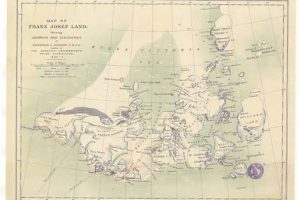
- Cartographic refinement: Jackson’s detailed surveys of the surrounding islands (including Hall, Bruce and Zemlya Georga) were compared with Nansen’s earlier sketches, leading to the first accurate composite map of the north‑western sector of Franz Josef Land published in 1897.
- Scientific data exchange: Nansen obtained meteorological readings from Jackson’s instruments, extending his atmospheric record for the winter of 1895‑96. Conversely, Jackson received oceanographic profiles from the Fram’s Nansen bottles, enriching the British understanding of Arctic water column structure.
- Survival strategy: The joint sledging journey in April 1896, undertaken by members of both expeditions, demonstrated that combined manpower could haul heavier loads across the ice, allowing the parties to retrieve scattered supplies from abandoned depots on nearby islands.
Outcome and Fate
When the Fram finally broke free of the ice in early July 1896, Nansen and Johansen returned to Norway, where Nansen’s polar drift theory was validated and his reputation solidified. Jackson’s expedition completed its intended scientific programme, mapping over 150 km of previously unknown coastline and publishing a comprehensive account, “A Thousand Miles in the Arctic” (1899). The successful collaboration at Cape Flora was highlighted in both men’s post‑expedition reports as a model of international cooperation in the High Arctic.
Historical Significance
Historians regard the Cape Flora meeting as a pivotal moment in the “Heroic Age” of polar exploration. It illustrated that even rival national expeditions could cooperate when faced with extreme environmental constraints. The episode also contributed to the later development of standardized Arctic rescue protocols and underlined the importance of sharing meteorological data—principles that later informed the operations of the International Polar Year initiatives.
Primary Sources
Nansen’s own narrative, “Farthest North” (1897), dedicates a chapter to the winter at Cape Flora, describing the arrival of the British party and the exchange of supplies. Jackson’s published journal, “A Thousand Miles in the Arctic” (1899), provides a detailed account of his expedition’s landing, the joint sledging trip, and the scientific collaboration. Contemporary newspaper reports from “The Times” (October 1895) also documented the meeting, emphasizing its diplomatic overtones.
Related Expeditions
Following the 1895‑96 winter, several later expeditions returned to Cape Flora, most notably the 1900‑01 Ziegler Polar Expedition, which used the abandoned British huts as a temporary shelter. During the Soviet era, the island was visited by the 1932–33 Chelyuskin rescue team, who noted the remnants of both Nansen’s and Jackson’s camps in their reports.
FAQ
Why did Nansen and Jackson choose Cape Flora for wintering?
Cape Flora offered a relatively ice‑free bay, a supply of driftwood for construction, and a flat, snow‑covered area suitable for tents, making it one of the few viable wintering sites in Franz Josef Land.
What supplies were exchanged during the meeting?
Nansen’s party gave seal meat and some spare clothing; Jackson’s party supplied tea, biscuits, a portable stove, and additional barometric instruments.
Did the meeting influence later Arctic rescue protocols?
Yes; the cooperation demonstrated the value of sharing resources and information, prompting later expeditions to adopt more coordinated rescue and communication strategies, especially during the International Polar Years.


Leave a Reply