
Short Answer
Fridtjof Nansen’s 1893‑96 Fram expedition is celebrated for its daring attempt to reach the North Pole by exploiting the Arctic’s east‑west trans‑polar drift. After eighteen months of drifting in the pack ice of the New Siberian Islands, Nansen and his trusted lieutenant Hjalmar Johansen abandoned the ship on 8 March 1895, equipped with sledges, a team of Samoyed dogs, and limited provisions. Their objective was to push onward to the Pole, but the harsh conditions forced a retreat that led them across the drifting sea ice to Franz Josef Land, where they wintered at Cape Flora on Northbrook Island.
Their so‑called “Franz Josef Land connection” became a pivotal episode in polar history. Not only did they set a new “Farthest North” record of 86°13.6′ N, but their successful withdrawal demonstrated that a small, well‑supplied party could survive the open‑water leads and ice floes of the high Arctic. The experience supplied crucial data for future Arctic navigation, influenced the design of later polar expeditions, and confirmed Henrik Mohn’s trans‑polar drift hypothesis.
Who Was Nansen / The Expedition
Fridtjof Nansen (1861‑1930) was a Norwegian zoologist, oceanographer and explorer who had already crossed the Greenland ice cap (1888‑89). Hjalmar Johansen (1867‑1913) was a seasoned Arctic skier and dog‑sled driver who had served with Nansen on several earlier ventures. The expedition was financed by the Norwegian government and private donors, and the sole vessel was the specially designed ice‑breaker Fram, built to resist crushing by pack ice.
Objectives
- Demonstrate that a ship could be frozen into the Arctic pack ice and be carried westward by the trans‑polar drift.
- Reach the geographic North Pole by sledging from the ship’s drift position.
- Conduct scientific observations of oceanography, meteorology, magnetism and glaciology during the three‑year drift.
Route
The Fram departed Bergen on 2 July 1893 and entered the pack ice north of the New Siberian Islands in August 1893. After drifting westward for about 18 months, Nansen and Johansen left the ship on 8 March 1895 at approximately 81°30′ N, 106° E. They travelled northward on sledges, reaching their farthest point of 86°13.6′ N on 7 May 1895. Following a forced retreat, they crossed open leads and navigated south‑westward, arriving at Cape Flora on Northbrook Island (≈81°21′ N, 57°35′ E) on 23 August 1895, where they built a winter camp.
Timeline
| Date | Event |
|---|---|
| 2 July 1893 | Fram departs Bergen for the New Siberian Islands. |
| August 1893 | Fram becomes ice‑bound and begins trans‑polar drift. |
| 8 March 1895 | Nansen and Johansen leave Fram with dogs and sledges. |
| 7 May 1895 | Achieve record latitude 86°13.6′ N – “Farthest North”. |
| 23 August 1895 | Reach Cape Flora, Northbrook Island, Franz Josef Land; establish winter camp. |
| March 1896 | Leave Cape Flora, travel southward via ice floes, reach Franz Julius Island and board the sealing vessel Jason for repatriation. |
| June 1896 | Return to Norway; Fram emerges in the North Atlantic. |
The Franz Josef Land Connection
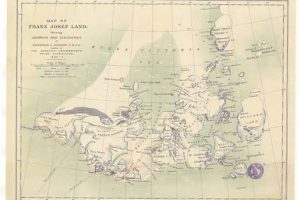
Franz Josef Land provided the only viable ice‑free haven for Nansen and Johansen after their retreat. Their camp at Cape Flora was situated on a narrow, windswept promontory of Northbrook Island, a location later used by several other polar parties (e.g., the 1900‑01 Baldwin–Ziegler Expedition). The party’s presence forced the first detailed mapping of the archipelago’s north‑eastern coast, and their observations were incorporated into the 1897 Russian hydrographic charts.
Challenges and Hardships
- Extreme cold: temperatures fell below –40 °C during the winter of 1895‑96.
- Limited provisions: the sledges carried only 200 kg of food for two men, forcing strict rationing.
- Open leads and pressure ridges: the retreat required crossing 30 km of open water on makeshift rafts.
- Scurvy risk: lack of fresh food was mitigated by hunting seals and polar bears whenever possible.
- Psychological strain: prolonged isolation and the knowledge that rescue was uncertain.
Discoveries and Achievements
- Set the “Farthest North” record of 86°13.6′ N, a benchmark that stood until 1909.
- Provided the first reliable measurements of the east‑west trans‑Arctic current, confirming Mohn’s drift theory.
- Collected valuable scientific data on sea‑ice thickness, ocean temperature, and magnetic declination during the drift.
- Produced the first accurate cartographic sketches of the eastern sector of Franz Josef Land, later incorporated into Russian and Austrian maps.
Outcome and Fate
After wintering at Cape Flora, Nansen and Johansen left the archipelago in March 1896, travelling south via ice floes to meet the sealing vessel Jason, which returned them to Norway. Nansen retired from field exploration, focusing on oceanography and diplomacy, while Johansen later perished in a Siberian accident in 1913. The Fram emerged from the ice in the North Atlantic in June 1896, having completed a three‑year drift without damage.
Historical Significance
Historians regard the Franz Josef Land episode as a turning point in polar exploration. It proved that a small, well‑prepared party could survive a forced retreat across the high Arctic, influencing later expeditions such as the 1909 Amundsen South‑Pole drive and the 1911–12 Scott Antarctic expedition. The successful wintering also demonstrated the strategic value of Franz Josef Land as a rescue and supply base, a role it later played during the Soviet era.
Primary Sources
The expedition is documented in Nansen’s own narrative Farthest North (1897), Johansen’s field notes (preserved in the Norwegian Polar Institute archives), and the official Fram logbooks edited by Henrik Mohn. Contemporary newspaper accounts and later scientific analyses of the Fram’s oceanographic data provide additional corroboration.
Related Expeditions
Earlier Austrian North‑Pole Expedition (1872‑73) first sighted Franz Josef Land, while later ventures such as the Baldwin–Ziegler (1901) and the Ziegler‑Fiala (1909‑10) parties used Cape Flora as a staging point. The 1912 Brusilov expedition also wintered in the archipelago, underscoring the lasting legacy of Nansen’s route.
FAQ
Why did Nansen and Johansen leave the Fram?
After 18 months of slow, erratic drift, Nansen decided the ship would not bring them close enough to the Pole, so he and Johansen left with dogs and sledges to attempt a direct northward push.
What was the significance of reaching Cape Flora?
Cape Flora offered the only ice‑free landing site in Franz Josef Land, allowing the party to build a winter camp, survive the Arctic winter, and serve as a base for their eventual rescue.
How did the journey influence later polar expeditions?
The successful retreat demonstrated that a small, well‑supplied team could survive the high Arctic, encouraging later explorers to adopt similar sledging tactics and to use Franz Josef Land as a logistical hub.


Leave a Reply