Short Answer
Location
Jackson Island lies in the central part of the Franz Josef Land archipelago, at 81°13′47″N 56°37′44″E. It belongs administratively to Arkhangelsk Oblast, Russia, and is uninhabited.
Map
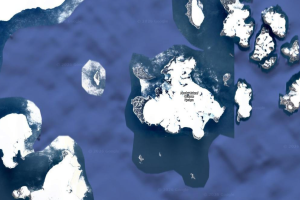
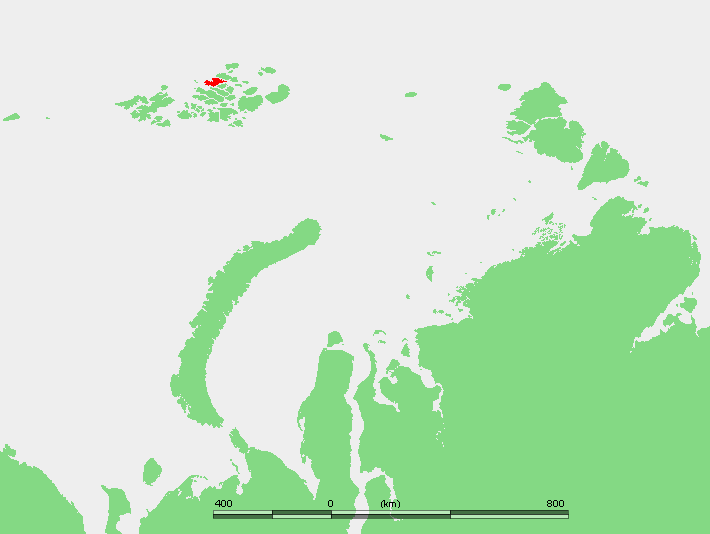 Modern topographic maps show Jackson Island as part of the Zichy Land subgroup. Historical charts from the Jackson‑Harmsworth Expedition (1894–1897) first recorded its coastline, while recent satellite imagery provides detailed outlines of its glaciated terrain.
Geography
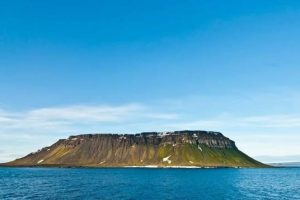
The island stretches roughly 40 km east–west and 30 km north–south, covering an area of about 510 km². Its western coast is indented by De Long Bay, named for American explorer George W. De Long, which almost bisects the island into two peninsulas. Cape Bystrova marks the southern boundary of the bay. The highest point reaches 481 m (1,578 ft) above sea level.
Glaciers
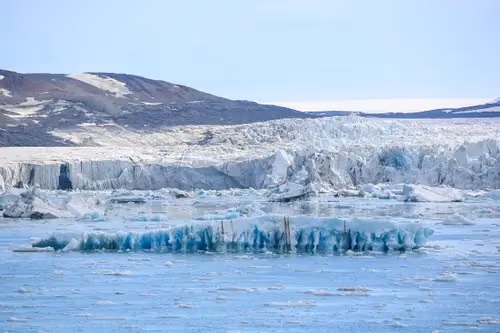
Jackson Island is heavily glaciated; ice caps occupy most of the interior, feeding outlet glaciers that terminate along the coast. The major glaciers include:
| Glacier | Location | Length (km) |
|---|---|---|
| De Long Glacier | Eastern side of De Long Bay | ≈8 |
| Northwest Ice Dome | Northwest interior | ≈12 |
| Southern Ice Shelf | South coast near Cape Bystrova | ≈5 |
These glaciers are monitored annually by Russian remote‑sensing programs to assess mass balance and climate response.
Geology
The bedrock of Jackson Island consists mainly of Precambrian granitic gneisses and metamorphic schists, similar to the rest of Zichy Land. The islands were uplifted during the Caledonian orogeny, and later modified by Pleistocene glaciations that carved deep fjords and polished rock surfaces.
Wildlife
Despite its extreme latitude, the island supports typical high‑Arctic fauna. Polar bears use the sea‑ice edge for hunting, while ringed seals and bearded seals haul out on the ice floes surrounding the island. Summer breeding colonies of little auk and ivory gull are found on the steep cliffs of De Long Bay. Arctic foxes are the sole terrestrial mammal, subsisting on carrion and bird eggs.
Exploration History
Jackson Island was named after English polar voyager Frederick Jackson, who explored and named many features of Franz Josef Land during the Jackson‑Harmsworth Arctic Expedition (1894–1897). In 1895, Fridtjof Nansen and Hjalmar Johansen, attempting a direct march to the North Pole, were forced to winter on the island after their sledges failed. They established a modest hut on Cape Norway (81°12′N 55°37′E) and erected a wooden post to mark their presence. The hut and post remain as tangible reminders of their endurance.
Historic Sites
The surviving wooden hut and the commemorative post on Cape Norway constitute the principal historic artifacts on Jackson Island. Both are protected under Russian heritage regulations and are periodically surveyed by the Arctic Institute of Russia.
Scientific Research
Since the Soviet era, Jackson Island has hosted occasional field campaigns focused on glaciology, permafrost, and climate monitoring. Recent Russian‑German collaborations installed automatic weather stations near the island’s summit, providing continuous data on temperature, wind, and precipitation. Biological surveys document changes in seabird populations linked to sea‑ice variability.
Name Origin
The island’s name honors Frederick Jackson (1860–1938), a British explorer who led several voyages to the high Arctic and contributed significantly to the cartography of Franz Josef Land. His 1894–1897 expedition mapped large portions of the archipelago, and he later served as president of the Royal Geographical Society.
Related Islands
Several smaller islands lie in the immediate vicinity of Jackson Island:
- Alexander Islands – a cluster off the north‑western tip, discovered by Nansen in 1895.
- Ommanney Island – a crescent‑shaped island 11 km north‑west of Jackson, named for Sir Erasmus Ommanney.
- Harley Island – a 10 km long narrow island 15 km west of Jackson, highest point 82 m, named for George Harley.
- Levanevsky Island – a tiny island 1 km south of Harley Island, commemorating Soviet aviator Sigismund Levanevsky.
- Kling Island – located 4 km west of Jackson’s southwestern tip, named for Captain Alfred Kling.
- Nich Island – a small island within De Long Bay.
- Magee Islands – two islets on the eastern shore named after Billy Magee.
- Querini Island – situated in a southern bay, named for Italian explorer Francesco Querini.
FAQ
Why did Nansen and Johansen choose Jackson Island for their winter camp?
After their sledges failed during the 1895 North‑Pole attempt, the duo sought a sheltered, ice‑bound location. Jackson Island’s De Long Bay offered protection from the prevailing winds, and the nearby sea ice provided hunting opportunities.
What remains of the 1895‑96 expedition on Jackson Island today?
The modest wooden hut constructed on Cape Norway and a commemorative wooden post marking the camp’s location have survived and are protected as historic artifacts.
Is Jackson Island currently used for scientific research?
Yes. Seasonal field teams conduct glaciological, meteorological, and biological studies, installing automatic weather stations and monitoring wildlife populations.


Leave a Reply